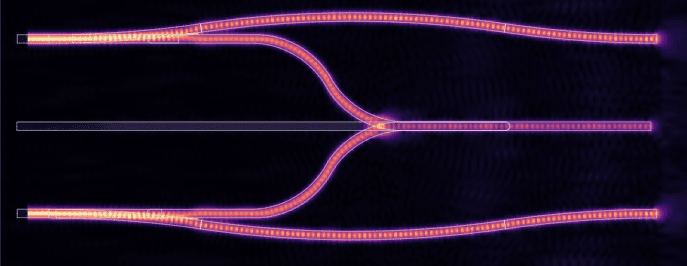
Tarranix develops its first guided-wave Toffoli gate using beam interference
A significant step toward fully optical logical circuits based on reversible photonic computing.
READ MORE
By Tarranix
Technology
Tarranix has designed its first vertical grating component to interconnect different logic gates within a 3D photonic device.
The goal of this project is to create a three-dimensional photonic system composed of photonic logic gates with outputs along the Z-axis. However, a specific component is required to capture the output of one logic gate and feed it as the input for the next, or alternatively, to route the light toward a sensor that determines its state.
To achieve this, we have designed a 6 µm-long vertical grating coupler that can be implemented just above the output of our photonic crystal slab.
Simulation in an ideal environment
The simulations were performed using silicon (Si) with a silicon dioxide (SiO₂) cladding, showing efficient light coupling between layers.
This approach allows vertical light outputs to be converted into horizontal inputs for other logic gates or photonic components. With this new development, Tarranix moves one step closer to realizing fully 3D photonic devices.To validate this, we simulated a single device with an output along the Z-axis using our vertical grating design positioned above the slab.
Preliminary results show:
Although some light dispersion remains and the coupling efficiency is lower than in the ideal case, the simulations demonstrate the feasibility of interconnecting multiple photonic components with Z-axis outputs within a 3D structure.
In parallel, we are also developing a silicon nitride (Si₃N₄) vertical coupler to further enhance performance and integration possibilities.
A significant step toward fully optical logical circuits based on reversible photonic computing.
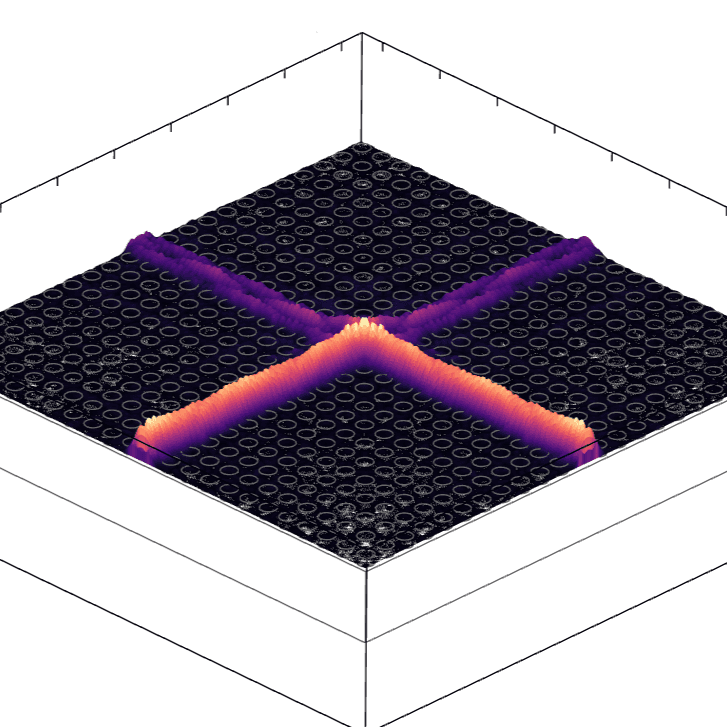
Tarranix has completed the first design phase of a photonic crystal (PhC) transistor with out-of-plane emission, adapted to the fabrication capabilities of UPC.
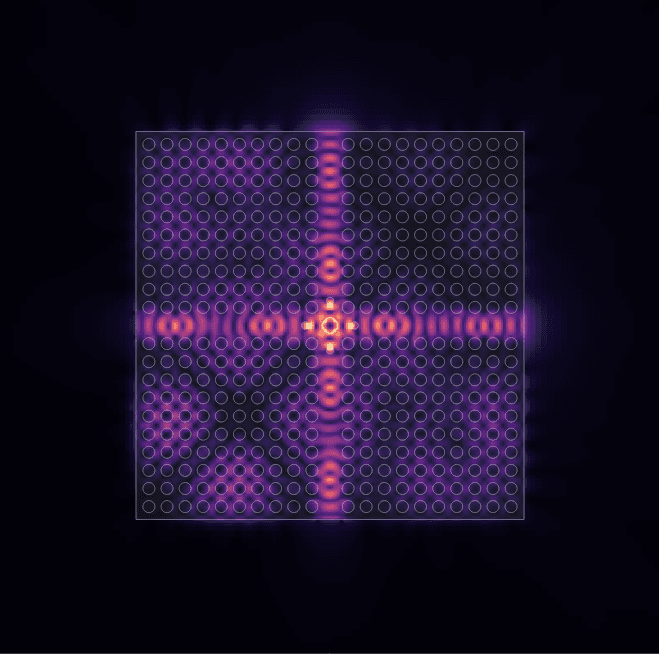
The Tarranix project has successfully completed simulations using a photonic crystal cross structure, making a key step in the development of optical logic with six logical states per transistor.